
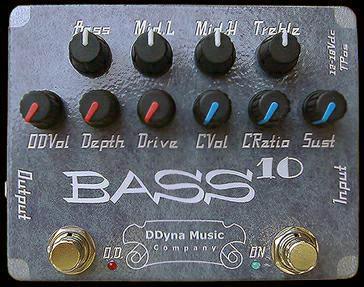
Righty-O here we go. We all have our own tastes, opinions, favorites, and go-to’s when it comes to gear. Whether it be an amp or pedal, guitar or set of pickups. This is what makes gear so special and what gives us all our own unique tonal voices. To me there is no such thing as better than – what might sound good to me or work for me may not work for another, and vice versa. This next collection of articles and reviews are our own personal favorites – pieces of gear that stood out to us in one way or another. There is not one piece of gear featured on this site that isn’t special to us, which is exactly why I started this site – to share with ya’ll my insight and experiences. I thought there’d be no better way to start this Top Finds than by hitting you with the long awaited Bass 10 from my good buddy Dan Simon of Ddyna Music. I can remember when I first became acquainted with Dan (some 2 years ago or so) and him running down his idea of what would become the Bass 10. I must admit that even way back then I was quite curious and eager to see the pedal come to fruition. Now that this pedal is in rotation amongst the world of us stompbox junkies, I will say it has surpassed every one of my expectations. The world of effects pedals is one that does not touch or work for every player. But for those that do choose to use these little metal boxes of magic and wonder, I say it does not get much better than this…. the Bass 10.
- Switching: True Bypass (TPDT)
- Input Impedance; 300k (min)
- Output Impedance: 4K (max at 5Hz)
- Input/Output Jacks: Neutrik 1/4″ Phone
- Current Consumption: (Operating) 60mA (max) – (Standby) 54mA @ 18DVC
- Power: 12VDC AC Adapter (Supplied)
- Voltage Range: 12.0VDC-18.0VDC
- Connector: 2.1mm x 5.5mm – Tip Positive
- Dimensions: 4.87(W) x 3.72(D) x 2.25(H)
- Weight: 0.92 lbs
- 100% Analog Signal
- Built with Top Notch Components in the USA
My first run-through of this magical pedal began with a Jazz Bass and Ampeg amplifier. I found this a great pair for hearing exactly what this pedal was capable of. I started by rolling the amp in straight up the middle, this giving me a neutral sweet sounding overall tone. The bass I played both with my fingers and pick. One giving me a warmer softer sound, and the other pumping out plenty of thump’n’boom. I dug into the bass, slapped the strings a bit, played soft jazz and R&B runs, and simple roots rock bass lines. I did this to get an exact feel of what the Bass 10 would do for me. Once my ear got adjusted to the clean amp tone I went ahead and set the pedal’s compressor. First I set the ratio to my liking, then the sustain, and last I worked in the compression’s volume. Before using the pedal’s EQ section to shape and mold my tone, I first played around with it to see how easily I could match the amp’s root tone. This in fact ended up being as easy as pie. Engaged, the Bass 10 gave my tone more clarity and control. I was able to hear the strings much clearer, the touch of my fingers, and the walking of the notes. Playing softly the pedal’s compression created this pillowy sound that sounded spec-tac-ular. The notes would jump out at me as if alive and breathing. I was able to maintain the tone’s character while at the same time fine tuning each corner and peak of the overall sound. This is where a killer sounding compressor can do you proper, and what no other effect will do. Once set to the Jazz Bass’ liking and kicked in, I found no reason to turn this pedal off. I found the compression channel very easy to use and very friendly to my attack. Here I began playing with the overdrive section and tuning in the EQ section to a bigger feel. I set the drive first to about 10’o’clock, started with the depth control back near it’s lowest setting, and last dialed in the overdrive volume. The EQ’s bass I rolled well past noon, the low mids at about 9’o’clock, high mids between 1 and 2’o’clock, and the treble at noon. In this setting the pedal provided me with more of a boost than an actual overdrive sound. It was the depth control’s position that made this possible. Rolling the depth clockwise converts the overdrive signal into a more of a square wave tone other than a round sound. This control alone makes the overdrive channel on this pedal very very versatile. Oh, and before I forget to mention – The overdrive section cannot be engaged unless the compression channel is in action. This keeps the overdrive signal in check, and with the EQ stack blended in the possibilities are damn near endless. Getting a dirtier bass tone from here was very simple. Just roll in a bit more drive and depth and you are home-free. With the depth right around noon, drive just passed 9’o’clock, and OD volume to my liking – I was able to get a nice balance of my root bass tone and th pedal’s dirty/compressed signal. I found this tone this tone worked great for jumping the dynamics in tunes and making things in general just sound much bigger. Here is where I discovered the range and possibilities of the Bass 10’s depth knob. By rolling th depth closer to 2-3’o’clock and rolling in a little more OD volume, I was able to take the same drive setting into even more of a grittier tone. With the EQ section things only got better. I was able to shape the overdrive signal into anything I wanted – a big fat dirt sound, or a thin bass cutting punching machine. Even fuzz tones were no problem wit this pedal. Before experimenting with other instruments I also did plug in a Danelectro bass and a active pickup ESP bass. With both of these basses ( as well as the Jazz Bass) I was able to shape them way beyond their character tones. Giving the Dano bass more aggression and softening the EMG’s signal were no problem. This proved one thing – Dan did his homework, making this a pedal fit for many types of bass guitars. Next came my guitars. I ran the exact same tests with a semi-hollow body, Strat, Tele, and Junior. The pedal’s compression proved to work much better than some of the guitar comp boxes I have come across, and the overdrive section did this really cool tight’n’gritty thing that blended really well with other guitar tracks ( both clean and dirty). One of my favorite though was playing this baby through a lap or pedal steel. Hands down one of the best tools for this type of instrument I have ever heard. In the end this pedal worked beautifully for both vintage and modern tones. As a tool for the bas guitar I could not recommend anything else. For those of you who dig multi-functional pedals this pedal is a dream. I myself am a huge fan of finding pedals that work just as good in the studio as they do on the stage. The Bass 10 is of this breed of stompbox. This of course is only a graze of the Bass 10’s capabilities… the rest is for you to discover.
