From the Source:
A
germanium/JFET booster. A unique sounding pedal which adds a beautiful
sheen to your bass’ top end and a bit of grit to the overall tone. It’s a
fantastic pedal for situations where you want a lift in your overall
level, during a chorus or bridge for example, with a bit of bawdy bump
via the germanium transistor.
One nice feature is also the more
modern JFET transistor at the input which keeps the pedal
impedance-friendly when it comes to active bass pickups. This helps the
Phat Phuk to remain consistent whether you put a P-Bass in front of it,
or a Warwick Thumb.
Another recommended use: As a simple preamp when
going direct into your DAW. Helps to de-sterilize your bass’s direct
tone and add a little life before the signal is converted to ones and
zeros.
Something else that was considered when creating the Phat Phuk
B. Many clean-boosts offer way too much boost in my opinion. In any
normal playing situation, including intentionally slamming the front end
of a tube amp to induce the amp’s natural overdrive, one really only
needs a hefty thump to get the job done. There’s nothing wrong with
having a large amount of volume on tap, but a problem that can sometimes
occur is a lack of ability to fine tune the amount of boost you want.
When the sweep of the knob goes from zero to melt-down with one turn of
the knob, it gets tough to really dial in a precise amount of boost.
Also a slight bump of the boost knob (with a foot or nervous “live show”
jitters) can send things out of control. I know because its happened to
me. Went for the big chorus during a song, hit the clean boost (not
mine, this was long before Wren and Cuff existed) and tore the heads off
the people in the front, pissed off the sound man, and pretty much
ruined that song. Therefore, the volume sweep was reduced with the
Phatty. You still get a big gob of gain, and probably won’t ever need to
run the pedal “at 11″, but the trade -off is worth the extra control.
Just an example of what Wren and Cuff prides itself on: pedals that
sound superior, look beautiful, can take a beating, and are made with
the “real world” player in mind.
In other words: A meticulous attention to detail.
A few notes:
1 – I posted the trace, board pictures, and schematic in the request section, here so everyone can take a look and check the trace.
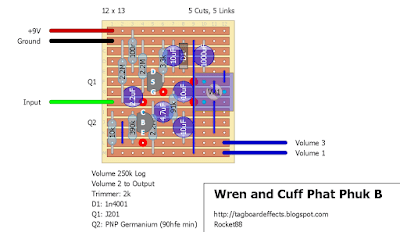
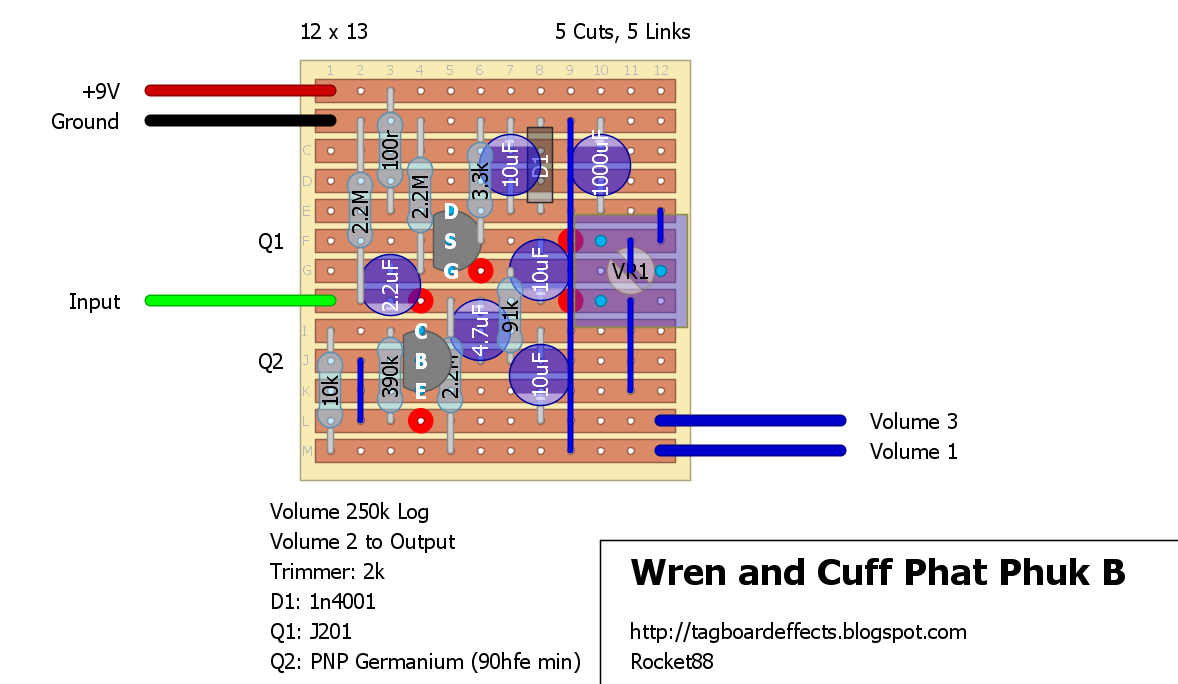
2 – the Germanium Transistor in Q2 is a Chinese Transistor with the markings removed, but what can be made out is AX9. This is PNP, but the hfe is unknown, but the good news is the schematic has been verified by JohnK, big thanks, with a PNP Germanium with 91hfe. So for now, as I put in the layout notes use a PNP Germanium with at least 90hfe, but by all means test it with other values. Don’t forget that if you’re using Russians that many times transistors with lower hfe seem to act similar to others of higher hfe.
Layout 1: