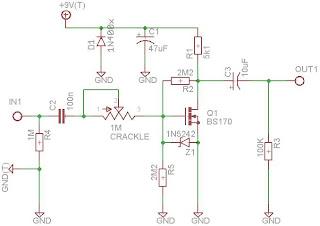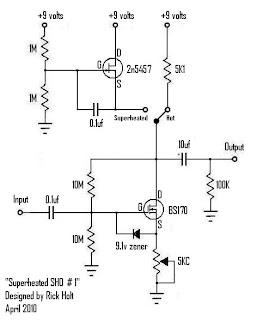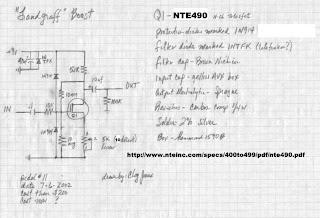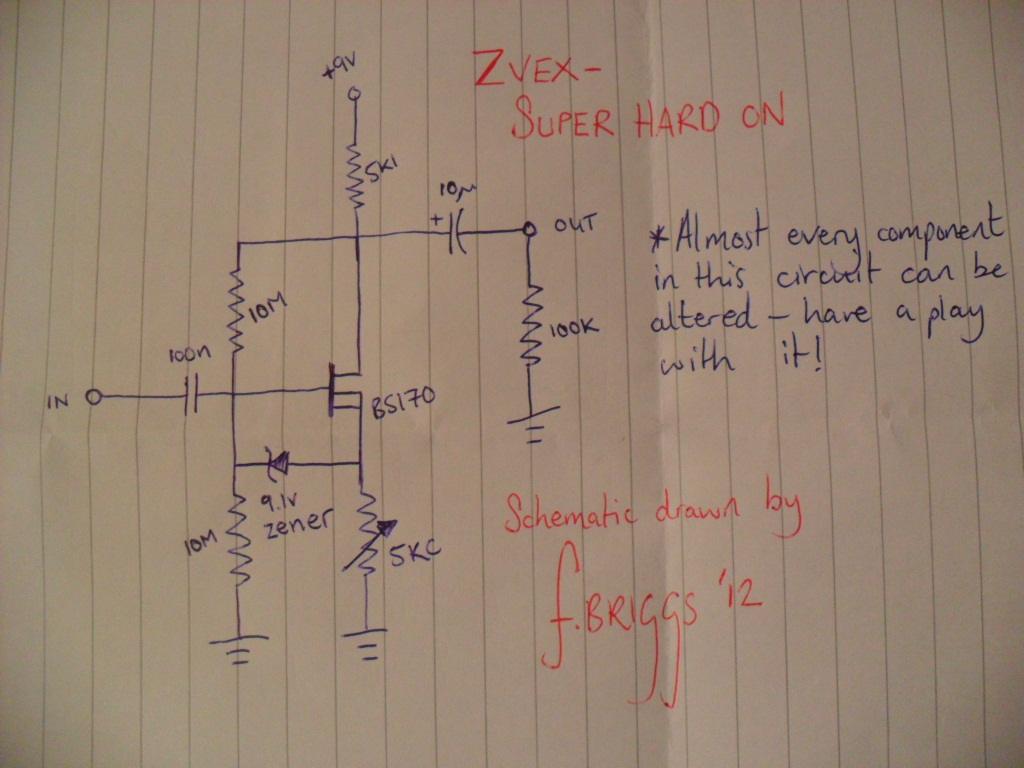

I didn’t realise I hadn’t put up a post for the Zvex Super Hard On – it’s one of my favourite little circuits. It’s a great booster and also a really good building block when you’re designing circuits…
Here’s the description from the Zvex website:
“This is the perfect preamp pedal. The “Crackle Okay” volume knob is a negative-feedback control styled after classic 60’s recording console inputs. (They crackled when adjusted too.)
Most vintage guitars suffer from steadily deteriorating magnets in their pickups, since permanent magnets aren’t really forever. The Super Hard-On’s input impedance is so high (>5 Meg) that it refuses any current flow from your pickup… maintaining the most magnetic field around each string, so you can hear exactly what your pickup sounded like the day it came off the winder.
The ouput level can exceed 8 volts peak, and when it finally distorts, the wave is shaped like triode overload, not fuzz.”
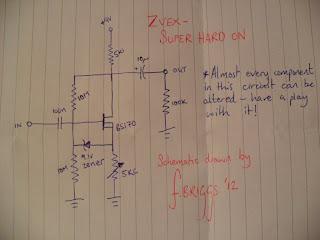
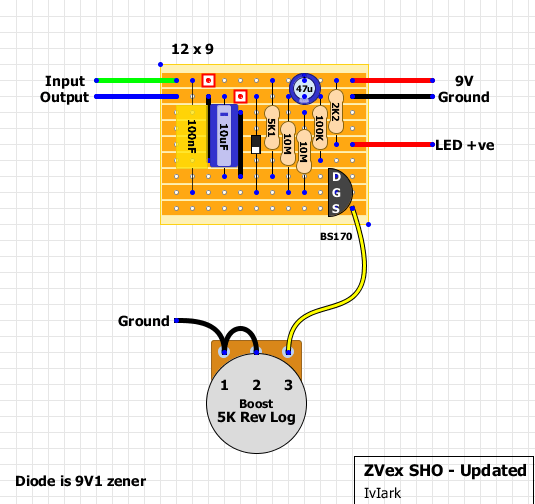
“The SHO is a deceivingly simple circuit. There is a lot going on when the source/bias pot is adjusted.
First, as the bias pot is adjusted from max (5k) down to min (0 ohms), the DC drain voltage changes roughly from 7.2V down to 4.0V. I have measured this in the breadboard and verified it in the sim (using a BS170 Spice model by Zetex).
Second, the gain varies from 0 dB to almost 40 dB as the bias pot is adjusted. Notice how the variation of the DC drain voltage tends to keep the dynamic range nearly centered. At min gain, drain and source resistors are 5k and 5k, respectively, thus the output can vary from about 4.5V up to 9V, and the 7.2V bias voltage is nearly centered. At max gain the output can vary from about 0V up to 9V, so the 4.0V bias voltage is again close to the theoretical center of the dynamic range.
Third, the input impedance of the SHO is not 5 Mohm as the popular belief dictates. No, it varies big time with the bias pot. At min gain, the end of the upper 10Meg resistor is tied to an inverted copy of the input voltage, not ground, so overall input impedance actually becomes 3.3Mohm when you do the proper math to find out the equivalent thevenin resistor (this has been verified in the sim as well). As the bias pot is reduced and gain increases, something very convenient happens: the input impedance starts going down, down to 140 kohms at max gain. This certainly helps taming the high frequency resonance of any guitar pickup (around 2-5kHz), thus taming highs and helping to the musicality of the clipping. Again, this is because the upper 10Meg resistor is effectively tied to a voltage source that is an amplified version of the input voltage, and not a simple ground point.”