
The COT50 has been a boutique favourite for a while now, it’s basic and effective and does produce some really nice tones. Here’s the description from the Lovepedal Site:
“Church of tone 50. The 50 is an ultra simple pedal, more like a tool in the guitarist’s tool box.
I use to go to these blues jams in Detroit MI. They always had some junky amp for jammers to play through. So I came up with this box that would simulate tube amp break up, give me enough of a boost to get above the band for solos and clean up very well with the volume knob on the guitar.
It has a very vintage plexi sound. It was designed to sound like a late 60s plexi loaded with 6550s. Through any amplifier, even a Solid State amp. It cleans up very well, when you roll back the volume knob on your guitar. This works like a pre gain adjustment.
The uniqueness of this unit is in the dynamics. A world of different subtle break up is available at the guitar volume knob. It cleans up so fast at the guitar most people leave it on all the time and work the guitar volume for everything they need. The knob is there for a bias adjustment. Hot biased or trimmed to original signal strength. If your the type of player that digs rolling off at the guitar. This is the pedal you want. Very crystal clear and raw uncompressed tone. This is the Billy Gibbons tone or early Hendrix sound. Depending on how you set the unit and the controls at your guitar.
The 50 has one knob that adjusts the bias of the transistor. This knob will make some noise when you adjust, the old Dallas Rangemasters did the same thing. Set the bias knob for the sweet spot, adjust volume knob on guitar to clean or dirty your signal. The 50 will push your amp! The switch for the 9 volt power supply is located on the input jack. So make sure you unplug the unit at the input jack to turn unit off. Carbon Batteries sound best to me (dollar store 2 for a buck). But try alkaline to see which you like best.
“Some of the best tones in this box come by simply adjusting your volume and tone at the guitar.”
There is a lot of different shades of gain in this box and it sounds great with any guitar/amp combination.”
EDIT – Demo video (Not me playing!) of the Clock of Tone 50 circuit ; http://www.youtube.com/watch?v=PFBIZkjEw34 :
EDIT 2 – Here is another sound sample, it’s got a master volume (470k pot at the end of the circuit) and a pot controlling the clipping threshold of the diodes (if I remember correctly a 10k pot worked pretty well..). It’s the “Electric Church Pedal”. http://skipregan.com/archives/535/electric-church-pedal/
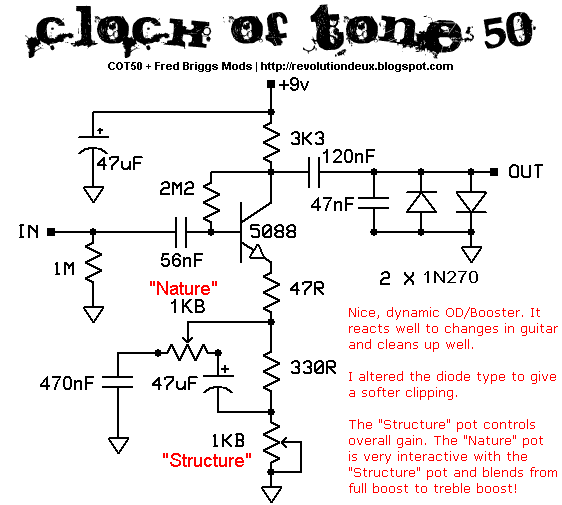
I tried a COT50 booster the other day – nice tone, I thought, but it could be better! So I got my breadboard out and modified away until I was happy! More bass response was a must so I changed th input and output caps from 47nF and 100nF to 56n and 120nF, only a slight difference but it’s enough to give your tone an extra thickness. Also I wanted to alter the clipping response slightly, it seemed a little harsh to me. I swapped out the 1N60 diodes used originally and went for some 1N270 Ge diodes, this softened up the top end a little. You can also see the 47nF cap in parallel to the diodes, this acts as a highpass filter and removes unwanted sizzle – no more “Icepick”. If you want those extra highs reduce the value of the 47nF cap 🙂
Finally, as always, I wanted more versatility. This is where I came up with the “Nature” control to accompany the already present “Structure” control. The Nature control allows you to blend between a full on thick boost and a rangemaster style treble boost, a nice feature to add I thought. The Nature knob is fairly interactive with the Structure knob, for example with the Structure knob at min and the Nature towards treble boost you get a pretty high treble boost but with the Structure at min (and Nature still towards treble) the treble boost is much less pronounced and it just takes away a little bottom end from you tone and prevents a muddy bottom end.
Well with those mods the COT50 became a useful little pedal… Just got to send the finished article back to my buddy now, see if he likes it 😉
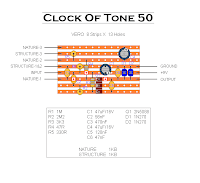
Here is a great vero layout for the Clock of Tone 50 from Torchy 🙂
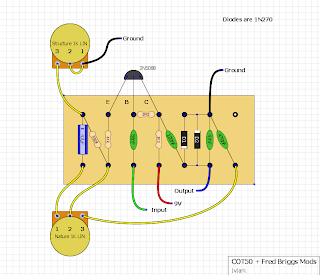
Here’s a mojotastic tagboard layout by IVIark of http://tagboardeffects.blogspot.com:
EDIT – Here’s a sound sample provided by AndreGarcia57 and it shows the differences in tone between transistor types BC108 and 2N5088, on low, medium and full gain settings:
“COT50 BC108 – 0 – 0s
COT50 BC108 – 10 – 30s
COT50 2N5088 – 0 – 56s
COT50 2N5088 – 5 – 1:10s
COT50 2N5088 – 10 – 1:29s”
Here’s the sample: http://www.4shared.com/audio/XB5sVR9Y/DRIVE50.html