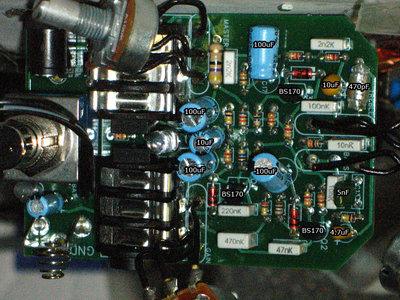

Live at LEEEEEEEEEDs! The Who – Live at Leeds is one of the best live albums ever recorded and one of the main reasons for this is Pete Townshends MASSIVE guitar tone created by his walls of super dynamic Hiwatt amps combined with a Univox SuperFuzz. Well – the Catalinbread “WIIO” pedal aims to give you the Hiwatt side of the equation and it does a damn good job of it too!
Firstly lets check out the Catalinbread description;
“Sheer raw power. Dynamics that feel like a roundhouse kick to the chest. Incredibly responsive clean up with the flick of the wrist. This is the WIIO.
The WIIO is an overdrive inspired by the powerfully unforgiving British amps from the ‘70s. Its all right there at your fingertips – your picking attack determines how much gain is delivered to the speakers. There is none of the typical compression found in most other overdrives to hide behind or to soften the blow – this is brass knuckle to the jaw type sonic impact we‘re talking here – you literally feel as though you plugged straight into the power section.
Like the amps, the WIIO has a wide freq spread so if your amp can deliver you’ll be rewarded with crisp clear highs and a very full tight low end. Lower gain settings are very clean and linear – you can hear every pick stroke and fingerprint, and the headroom allows for some very rich sounds when using modulation pedals. As you crank up the Gain the breakup is aggressive, powerful, punchy, and immediate then it decays quickly to a full clean sound. The midrange bark particular to the amps on which we based the WIIO is right there too as you crank it up. This pedal cuts like a broadsword so no need to fear being lost in the fray. It respects the integrity of your pickups, and loves being slammed with other overdrives or your favorite fuzz too.
The EQ controls on the WIIO are interactive with the Gain knob – increasing the Treble will not only give you more highs but also more grit to the gain. Likewise, increasing the Bass control will not only deliver more lows but will also alter the feel and attack. Plenty of output to smack your amp into submission as well.
The whole point of the WIIO experience is the dynamic interaction between you and the pedal. It reacts immediately to your picking hand, so cleans are easily attainable just by lightening up your attack. Conversely, you can get to the raging power chord stuff just by hitting the guitar harder. Running the WIIO at full gain will give you pushed transformer-style saturation for leads as well, so in reality you can have three levels of gain available just by using your wrist and your guitar’s volume control. It was designed to be intuitive with a minimum of tweaking, freeing you to follow your inspiration to wherever it takes you.
The WIIO won’t be for everybody and we‘re cool with that – hell, Nic has the real deal 100w full stack with eight Fanes and many of us in Teh Bunker cower and lose continence when its at full bore. Its unique sonic structure is very unforgiving and due to the responsiveness allows EVERYTHING you put into it to come through. But as the players who have had the experience of playing the amps know, there are great rewards to be had once you’re able to grab hold of the reins and attempt to ride the mighty beast.”
Now a demo vid;
Moving on lets check out these gut shots;
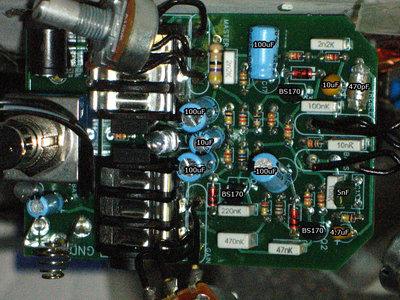
Looks like it’s a cascaded BS170 mosfet design. From past experience we know these sound good – check out the Zvex Box of Rock for one example of a similar circuit topology.
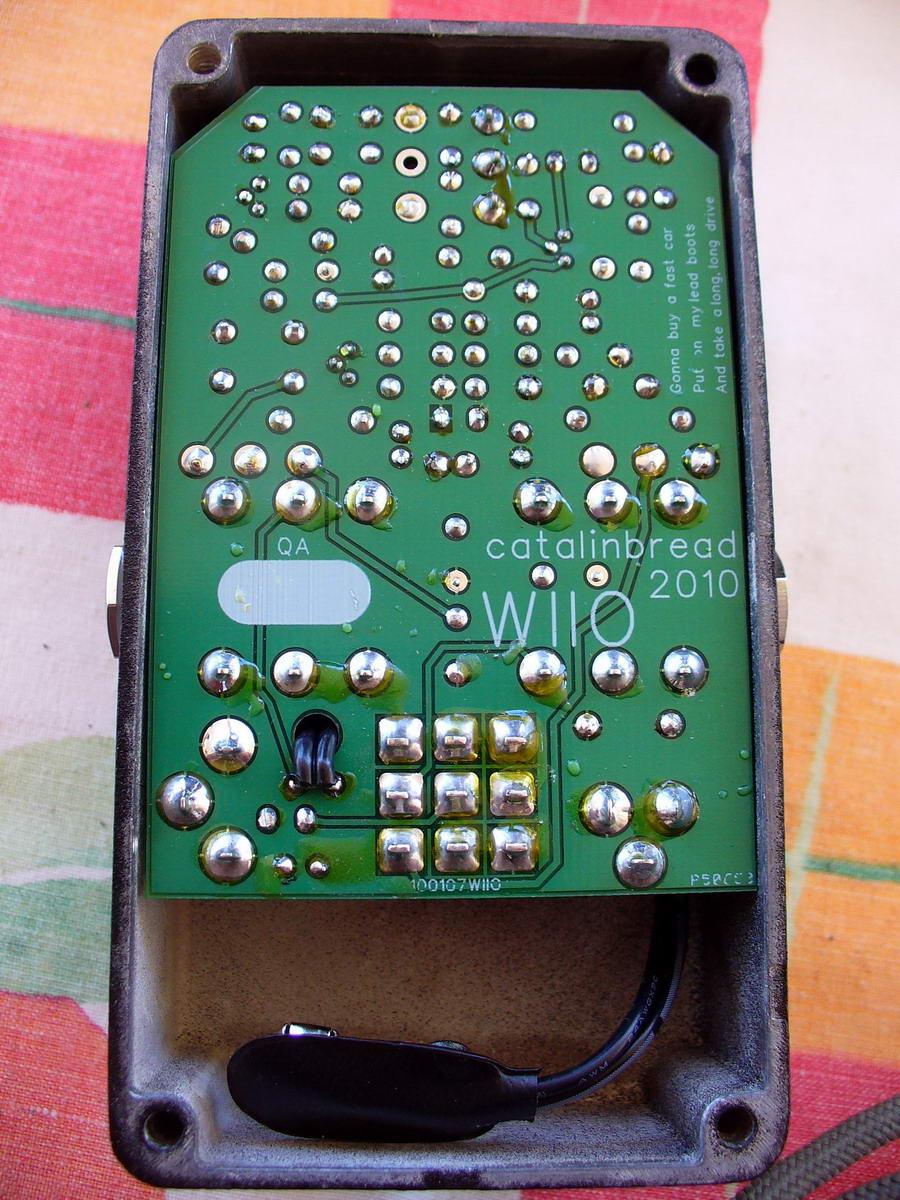
Once again the tracing king that is WhiteKeyHole provides a schematic;

It’s a pretty standard cascaded mosfet design: two gain stages into tonestack into a final gain stage. Note a few interesting design choices which make this mosfet pedal stand out;
1) The negative feedback from the third gain stage via the 200k resistor & 470n cap- this lowers the gain back earlier on in the signal path – it’s an old trick used on many tube amps to tame the gain of the preamp. I like this approach to signal gain control – the BJF HoneyBee and Dyna Red Distortion also make use of feedback to lower higher frequency gain levels and it really works a treat by adding in another level of dynamics into the playability of the circuit. *NOTE* An interesting modification to this circuit would be to replace the 200k feedback resistor with a 500kB pot. Also try fiddling with the value of the cap – smaller values will retain more highs…
2) The biasing of the mosfets – not just 4.5v but altered via the offset 62k/100k voltage divider. Biasing the mosfets away from a central 4.5v forces them into asymmetrical clipping instead of their standard symmetrical clipping. Asymmetrical clipping better mirrors the manner in which a tube amp clips.
Here’s a vero layout by ShortScaleMike:

And a link to the freestompboxes.org forum topic; http://freestompboxes.org/viewtopic.php?f=7&t=8046
Now, moving on, we’ve got the Catalinbread RAH (Royal Albert Hall). Why have I posted it together with the WIIO? Because it’s roughly the same circuit with a few tonal tweaks.
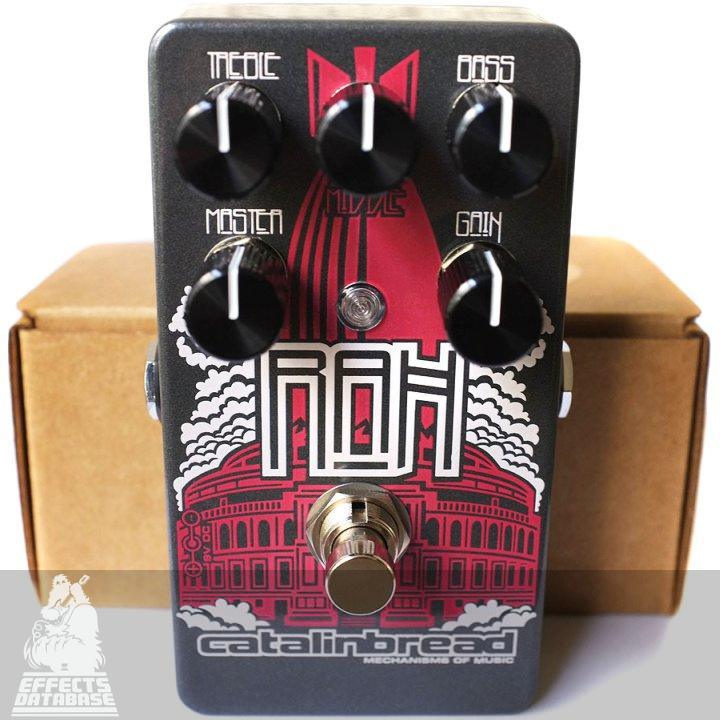
Firstly, lets check out the Catalinbread’s website description of the RAH:
“In January 1970 Led Zeppelin hit the stage of London’s historic concert hall, Royal Albert Hall. At this performance Jimmy Page expressed himself masterfully with a broad pallet of tones and GIANT dynamic range. Of course this has a lot to do with Page’s playing technique and Gibson Les Paul. His backline amps, custom Hiwatt heads into Marshall cabinets filled the entire hall with a cornucopia of colors at levels ranging from a mouse whisper to rave ups louder than a jumbo jet taking off only inches over your head.
At Catalinbread we love the RAH performance, but we hadn’t considered the possibility of capturing it to put into a pedal… One day our friend Charlie got ahold of Catalinbread’s chief circuit designer Howard Gee to ask if we could do it. Charlie said that he’d been trying to get this tone for years and told Howard, if anybody can do it is Catalinbread. Having proven his ability capture the essence and experience of famous amplifiers, Howard began experimenting with what is now the RAH.
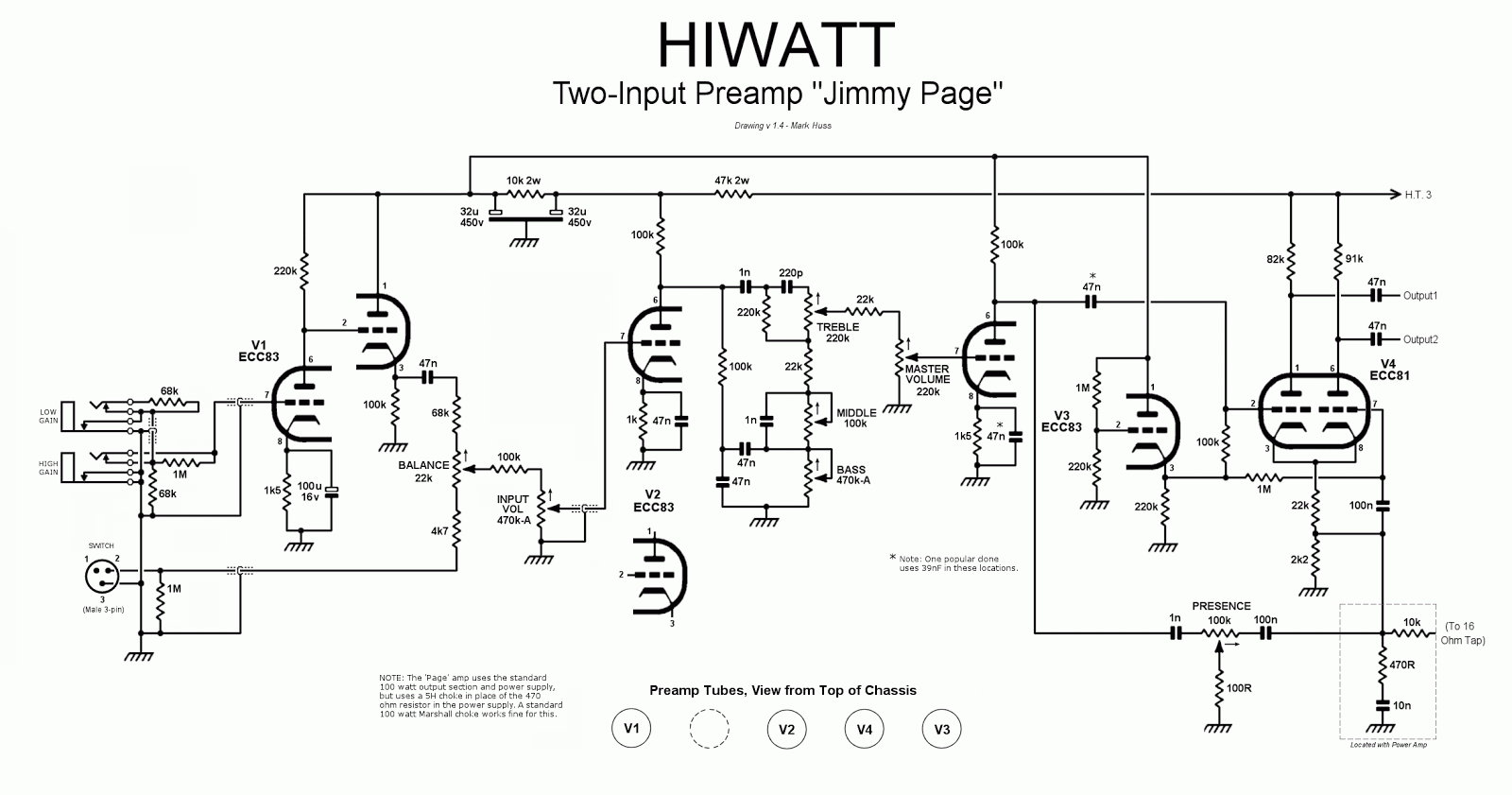
The RAH features the specific three-knob tone circuit straight from the custom “Jimmy Page” model Hiwatt. Like most traditional amp EQ circuits, the knobs are interactive, meaning turning one can alter the behavior of the other. The magic is getting the Mid and Bass controls dialed in together. Tweak those until you get the right tone for your guitar and amp. You’ll notice that the Treble knob is fairly subtle, adding a bit of bite as it is turned up. If you scoop the Mid and turn up the Bass however, the Treble knob will seem a lot more active.
The RAH is designed to deliver guitarists an incredible dynamic range that responds to picking hand and and/or volume knob. Like a good amplifier the RAH is VERY uncompressed, which means there is little to “hide behind”. This pedal is for players who appreciate the rewards and experience of a WIDE dynamic response. Plug the RAH into a clean(ish) tube amplifer, leave the pedal on all the time accessing clean tones rolling back your guitar’s volume knob, or turn it on and off as your “gain channel”. “
And a proguitarshop demo video:
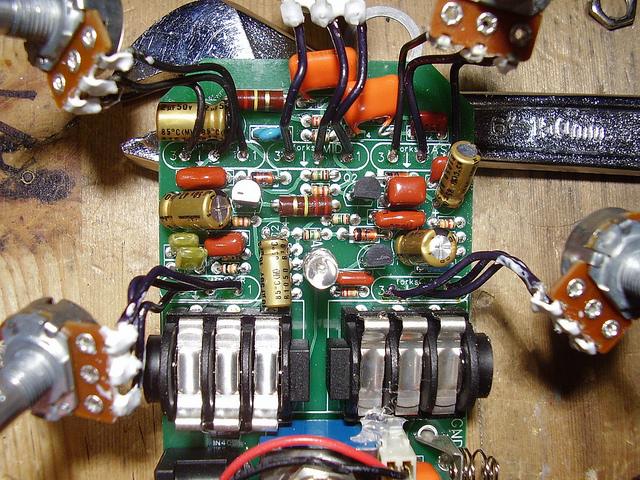
Here’s some guts:
And a schematic:
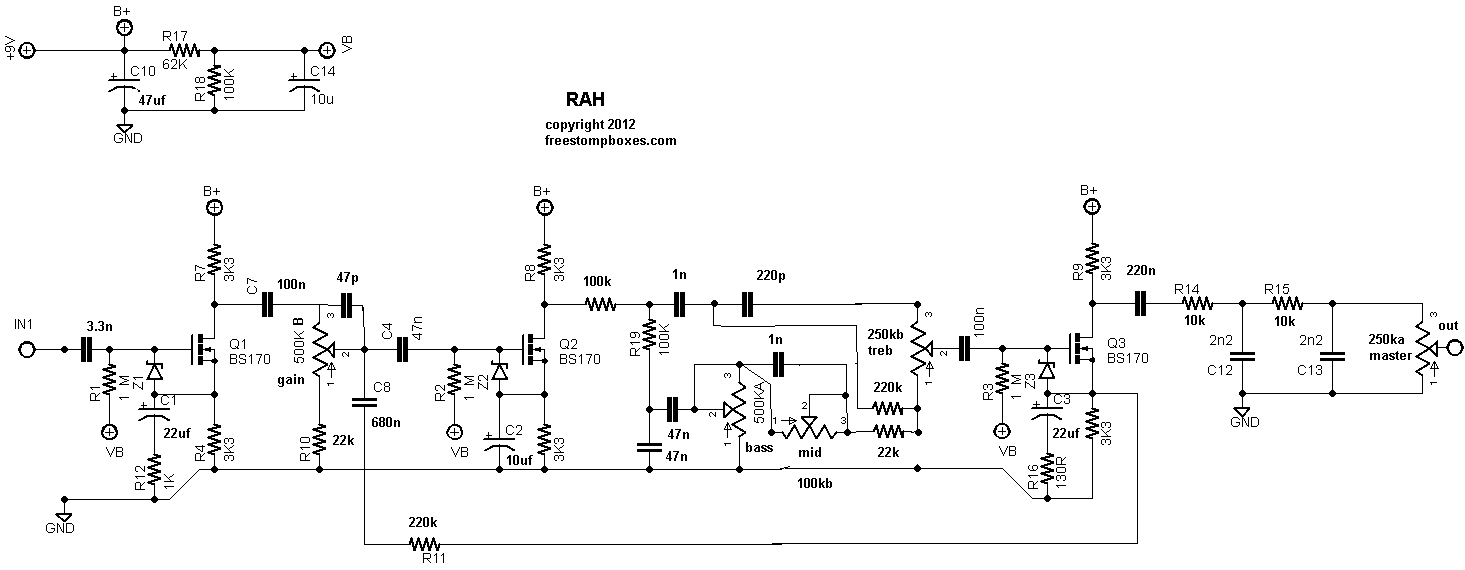
As you can see the RAH is the same basic circuit as the WIIO (it makes sense – they both aim to emulate hiwatt amps!). The tonestack of the RAH is lift straight from the Hiwatt DR 2 input preamp that Jimmy Page was supposedly using that evening;
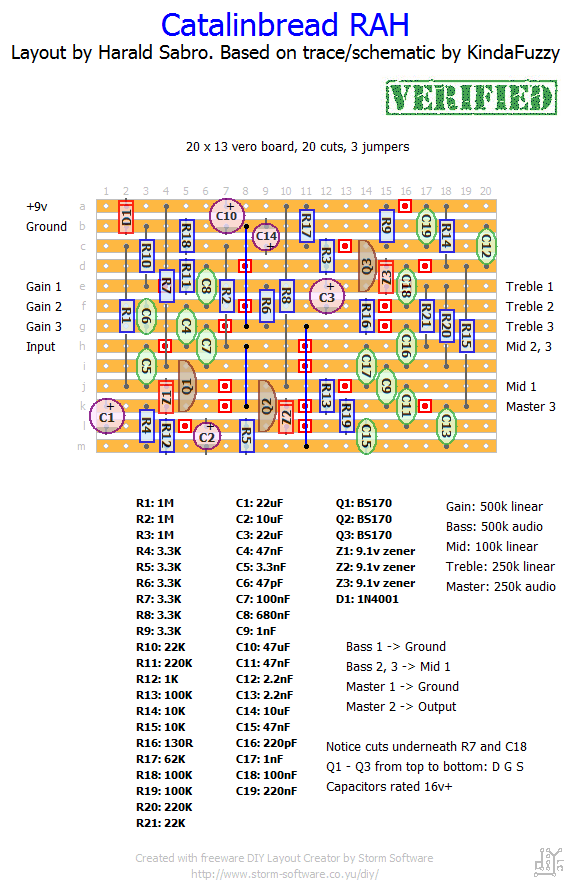
So, you wanna build one? Well here’s a layout by Harald Sabro;
And finally, for reference, here’s the freestompboxes.org forum topic for you; http://freestompboxes.org/viewtopic.php?f=7&t=16922