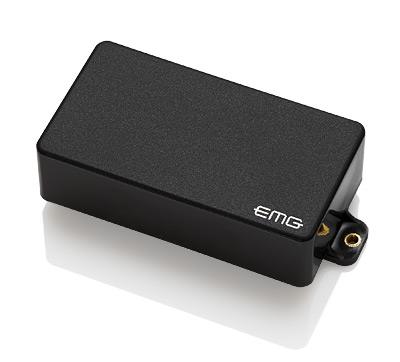
The EMG 81 is now ranked as a “classic” humbucking pickup – for years it has been the go-to choice for Shred and Metal guitarists thanks to it’s monstrous voltage output (making it a doddle to overdrive a preamp!) and searingly smooth high frequency response which allows guitarists to cut straight through all the sludge of the bass and drums, and, depending on the band – the singing too 😉
Here’s a description of the EMG 81 from the EMG Website;
“One of the most popular EMG’s the 81 is the one that started a revolution. Utilizing powerful ceramic magnets and close aperture coils, the tone was designed with detailed intensity, incredible amounts of high end cut and fluid sustain. Traditionally used in the bridge position, this pickup will make your leads slice right through even the densest mix. When used in both neck and bridge positions the sound can only be described as blistering.”
And a demo of the EMG 81 in action and in comparison with some other EMG actives;
“Magnet: Ceramic (cutting) 56x3x13mmWire: 0,06mm (Plain Enamel) (#42 AWG)
Core: 54x3x12,5mm (silicon steel?), solid steel.
Coil: 4,18KOhm (one coil), wax potted, aprox. 5700 turns, h=7,5mm
Bobbin: 64x13x9mm (or with “tube legs” 12,2mm)
Coils conection:
-opamp——–^^^^^^^^—–ground—-^^^^^^^^^^———opamp+
IC unknown, marked as EMG001″
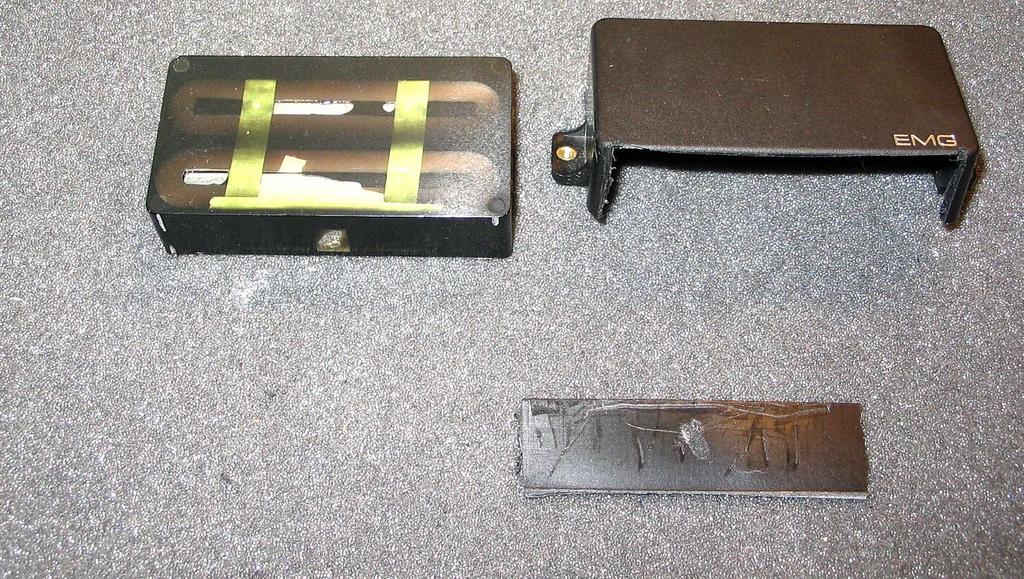 |
| Cover off, wax potted coils and ceramic magnet |
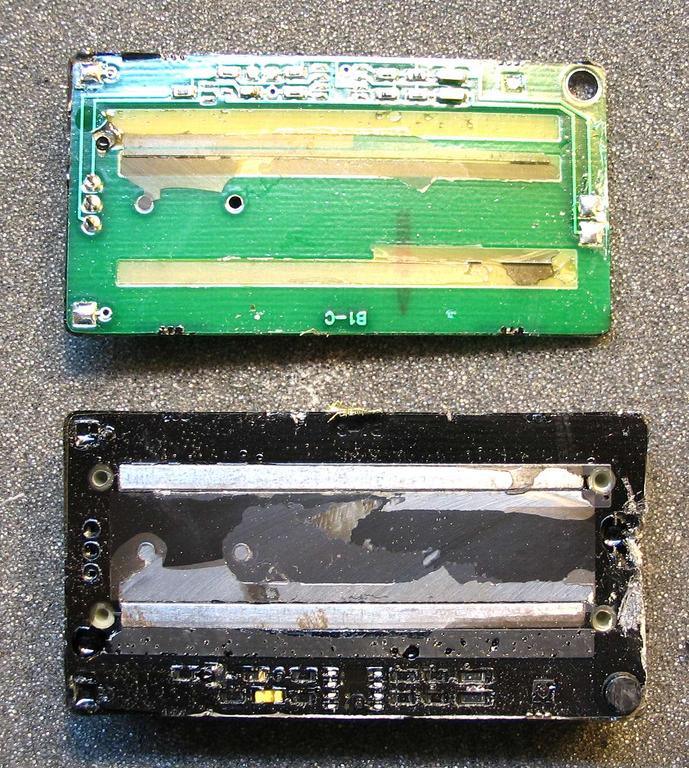
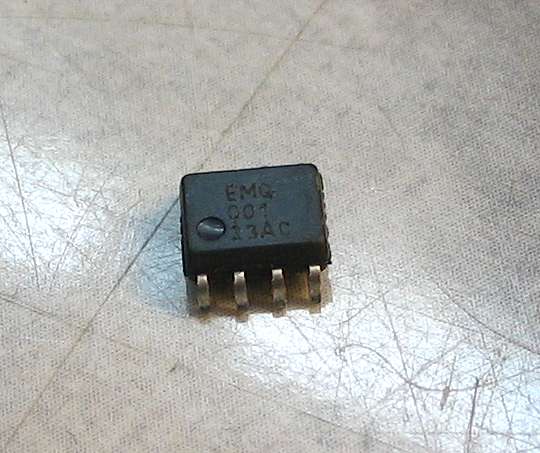 |
| The mystery EMG chip (suspected LM4250) |
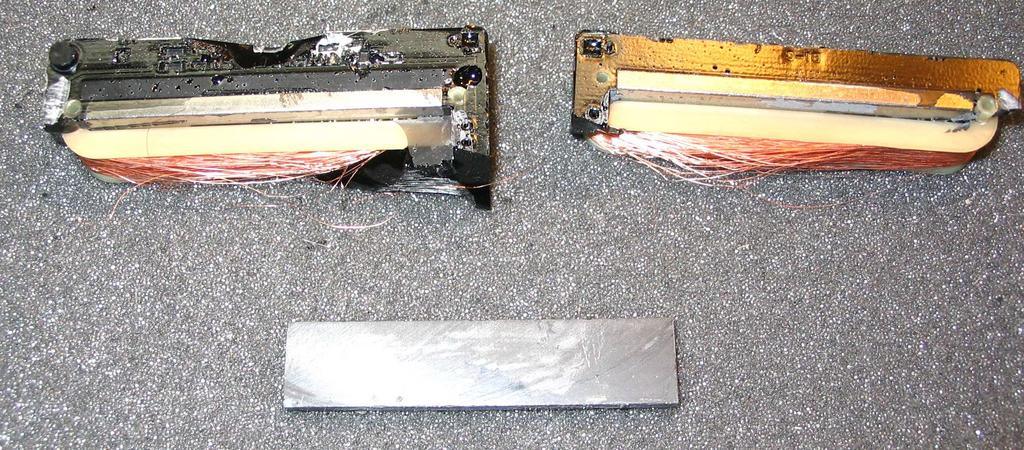 |
| The coils and solid steel blade bobbins |
Furthermore the guy who gutted the EMG 81 also traced out the circuitry inside – here’s the schematic of the active circuit;
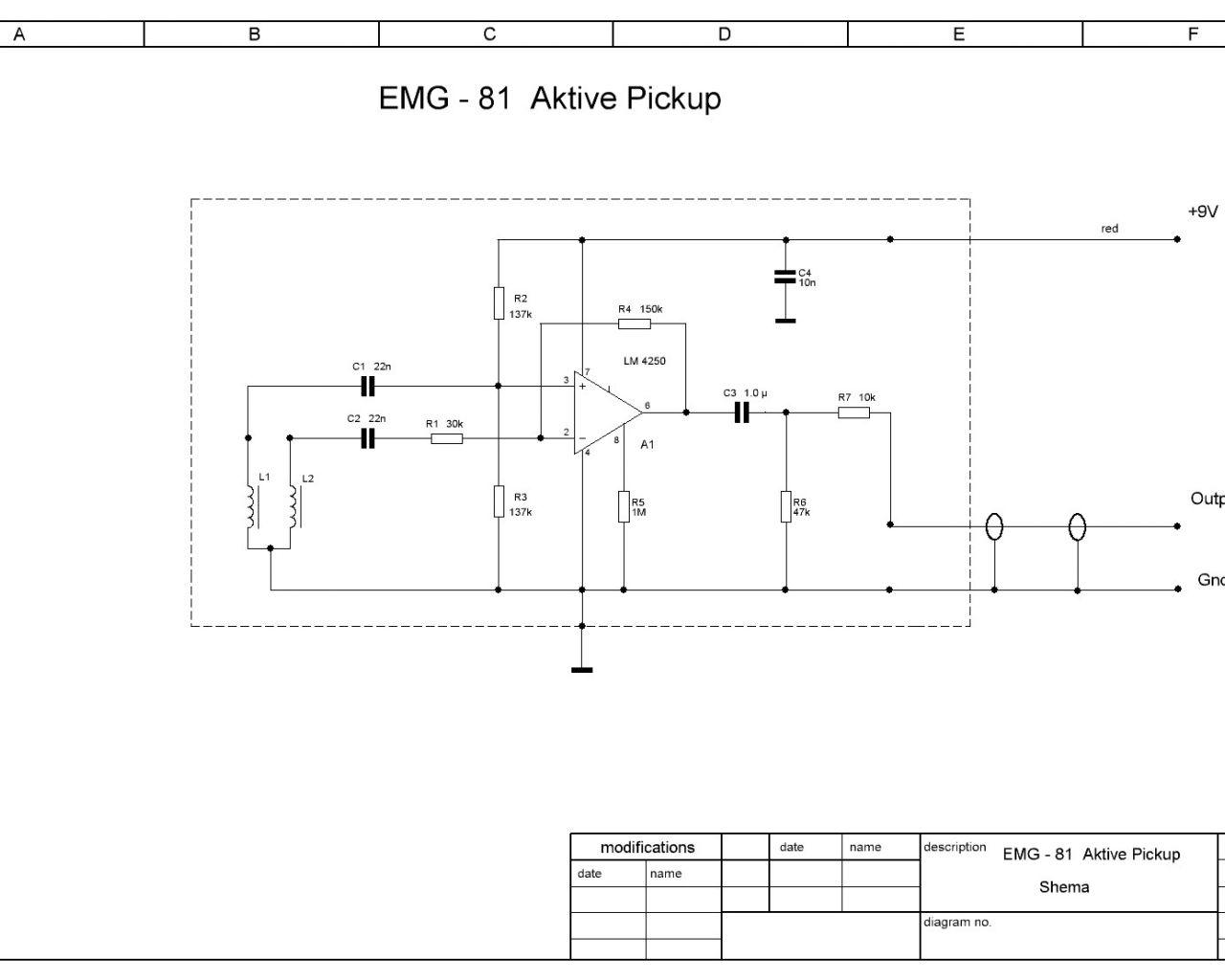
Now the freestompboxes.org forum has had a good look at this and the main proponent to it’s development and implementation was the great Bajaman. Here’s some of his key posts (edited slightly by myself for clarity);
First up is a post regarding the original schematic;
“Referring to this scheme it is easy to see that it is a classic differential amplifier circuit stage – any noise or hum appearing on both coils gets attenuated in the same ratio as the overall gain. In simple terms we end up with a very quiet and super humbucking pickup, BUT in the EMG81’s case there exists a slight imbalance in the differential arms. Although both coils feed via 22n dc isolating coupling capacitors, the coil connected to the non inverting input is missing it’s source resistor – in the schematic’s case 30k. In practice this will not make much difference if any to the noise cancelling efficiency but it will create some imbalance of signal gain in the higher frequency region where the rising coil inductances come into play.”
And some quick info on the LM4250;
“The LM4250 is a programmable current op amp with a specific pin out configuration. You set the operating current (and slew rate) with one external resistor – in this instance a 1M value sets the current draw to 80 uA for a very long battery life.”
Here’s some info on a pair of active humbuckers he constructed using the EMG plans;
“I wound two of the Stewart McDonald alnico humbucking pickups last week and attached two EMG style differential preamps on the bottom nickle silver base of each pickup. I soldered the through hole components on the copper track side of the PCB, then filed the leads flush with the plain side of the board. I inserted a small sheet of mylar overhead transparency film between the board and the baseplate to avoid shorting anything to ground. I soldered the earth bus at each end of the PCB to the baseplate of the pickup and ran a small bead of glue to hold it firmly in place. I laid the film caps and the electrolytic on their sides to keep as low a profile as possible and to assist soldering to the PCB.I wound around 8000 turns of 42 gauge enamelled copper wire (.050) on each bobbin and connected the start of each coil to the metal baseplate.
I wanted to retain the sound of a high output side by side humbucker, so I used a resistor in series with the non inverting input, unlike the EMG 81 which has no resistor fitted and consequently has a more single coil resonance. I used larger biasing resistors (330k each) unlike the 170k resistors fitted to the EMG 81, because i did not want to damp the resonance and shift it’s frequency too far down – i suppose I could have used 1M resistors for an even brighter and higher resonance, but in practice the pickups sound very nice. I tried them out with my band mates at practice in the weekend and they were most impressed with the lack of noise and the smooth sound I was getting without any pedals.
It should be possible to fit the active preamp boards to most un-encapsulated humbucking pickups. All that is required is to separate the wire connecting the two coils in series and bring each coil winding out to the non inverting and inverting terminals of the differential preamp board – the existing output is simply grounded by connecting it to the baseplate.”
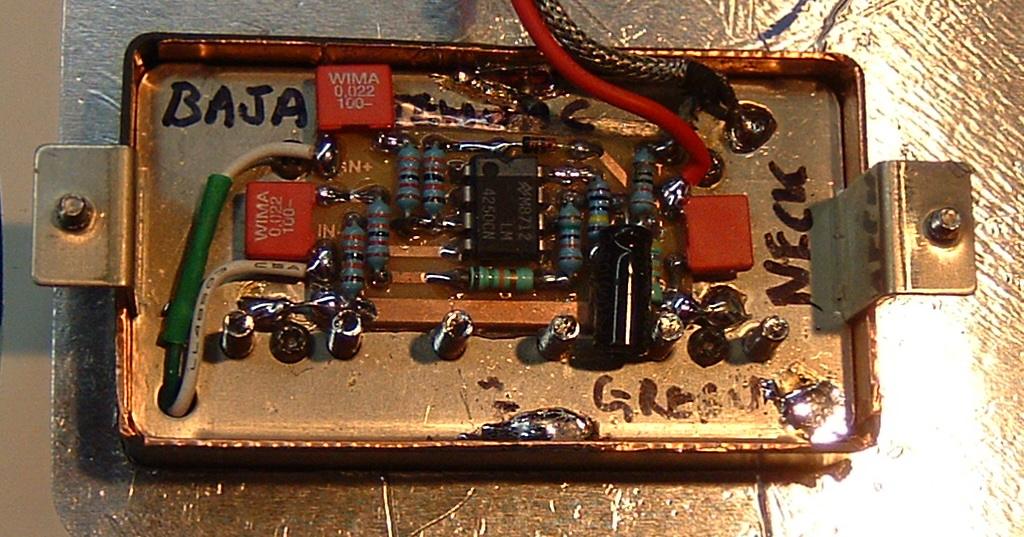 |
| One of Bajaman’s active humbuckers |
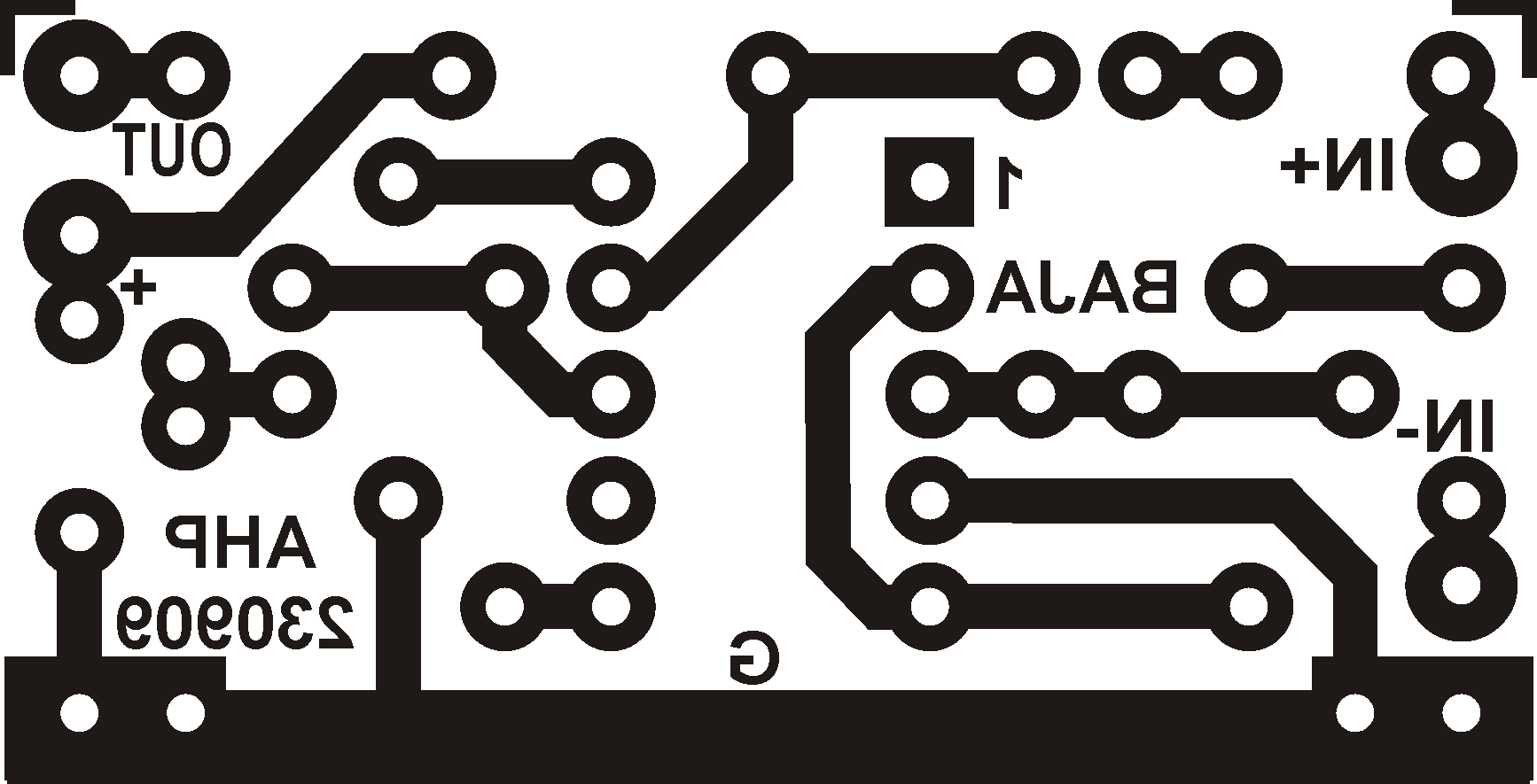
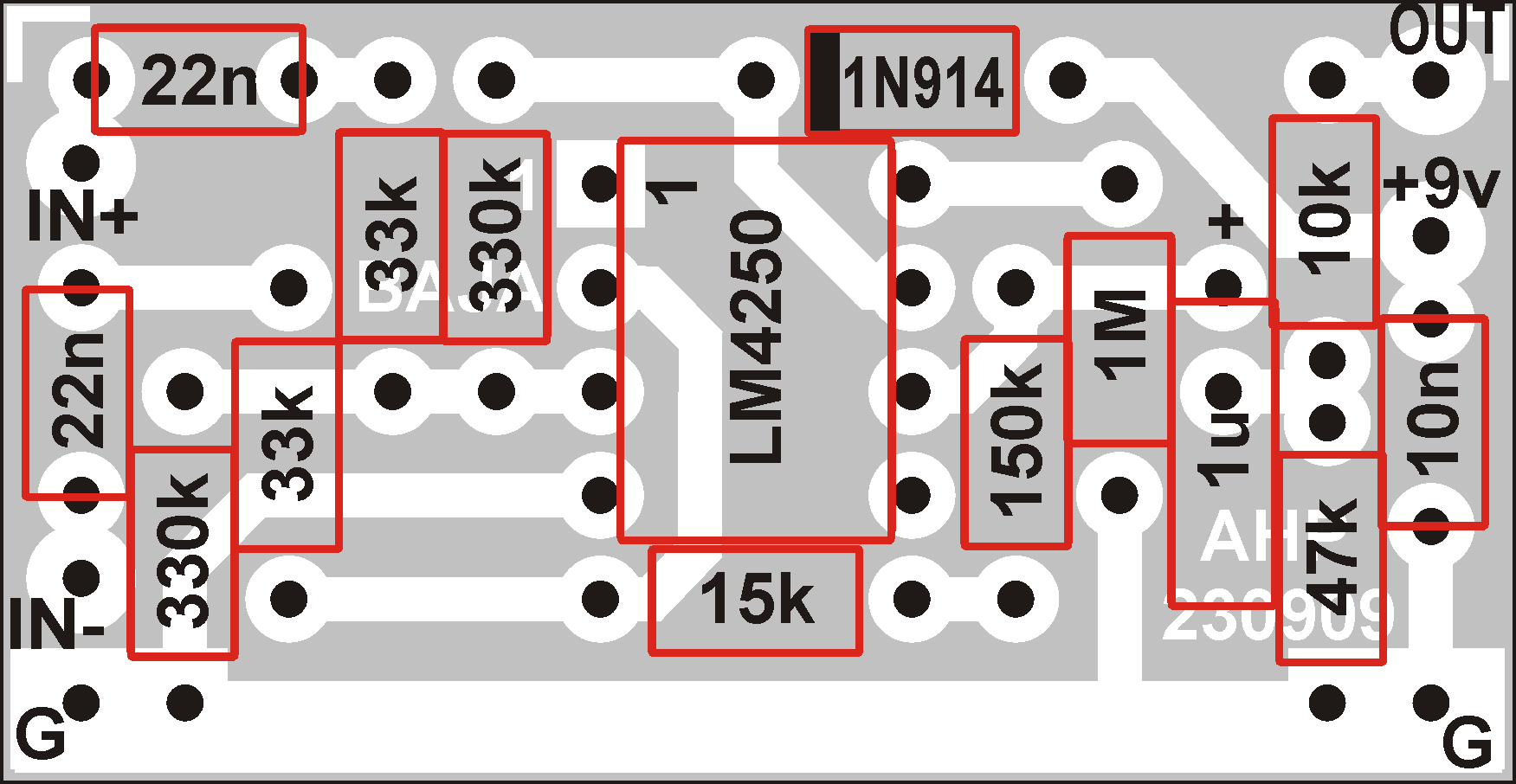 |
| PCB Layout for active humbuckers |
Here’s a post regarding how each component can be altered to affect tone;
“The component values can be altered to tone model your pickup to your taste.I would encourage reducing the 33k in series with the non inverting input – possibly with an external trim pot to dial in the brightness of the pickup – reducing this to zero should give a more single coil like sound perhaps while still retaining the noise cancelling properties of the differential gain stage.
ALSO – the 22n capacitors can be decreased for less bottom end response OR the two 330k resistors can be reduced or increased in value – this will alter the pickups resonance – lower values should lower it’s effect and possibly shift the resonst peak down in frequency – higher values (say 2.2M) should give a much more pronounced resonance at a higher frequency for a brighter sounding pickup.
The 1M resistor can be increased for still lower current drain but reduced top end response, or increased for a brighter top end but lower battery life.”
And a post detailing some changes he made to his circuitry and the affect these had on the pickup’s tone;
“I noticed that the high frequency end of the pickup’s response was a bit restricted (perfect for jazz guitar players) but not enough “bite” for my liking. As mentioned in my last post i wound two pickups (4 coils), each coil wound with 8000 turns of .050 wire on Stewart McDonald alnico humbucking pickup kits. Most Gibson pickups used in Les Pauls and 335s etc. use 500k volume pots which load down the coil and tame it’s high frequency resonance. If you have ever fitted a humbucker in a Strat style guitar with 250k pots you will know what I am talking about – the resonance and “bite” of the pickup is nowhere near as bright sounding with this lower resistance in parallel damping the coil’s response.
Well – i took another look at my differential preamp design – I was using two 330k resistors to bias the non inverting op amp input to 4.5v dc. These resistors are effectively in parallel if one ignores the low impedance of the battery supply – or 165k, which is a very low resistance in parallel across the pickup coil, and here is the problem!!
For the differential amplifier to work correctly the feedback resistor from the op amp’s output to the inverting input also needs to be this value ( 150k + 15k = 165k).
So how do we load the coils with 500k – simple, we use two 1M resistors as the bias resistors and two 1M resistors in parallel with each other for the feedback resistor. We do get a little more gain from the higher value resistors which is not necessarily a bad thing as it turns out because the sound is now a lot better with an almost identical “bite” to a genuine Gibson high output (not an SG) Les Paul pickup when the volume control is set to 7. The extra output gives a really nice fat response that easily overdrives most clean channels on tube amps etc.
I have A B tested my guitar fitted with this pickup and preamp configuration and another guitar i have fitted with two EMG81 pickups and it makes the 81s sound very thin and lifeless in comparison.
The humbucker “squark” is there in spades with no discernable noise whatsoever – even in front of a computer monitor.
When I turn the guitar volume from 0 to 10, I cannot hear any increase in noise whatsoever, which is eerie to say the least.”
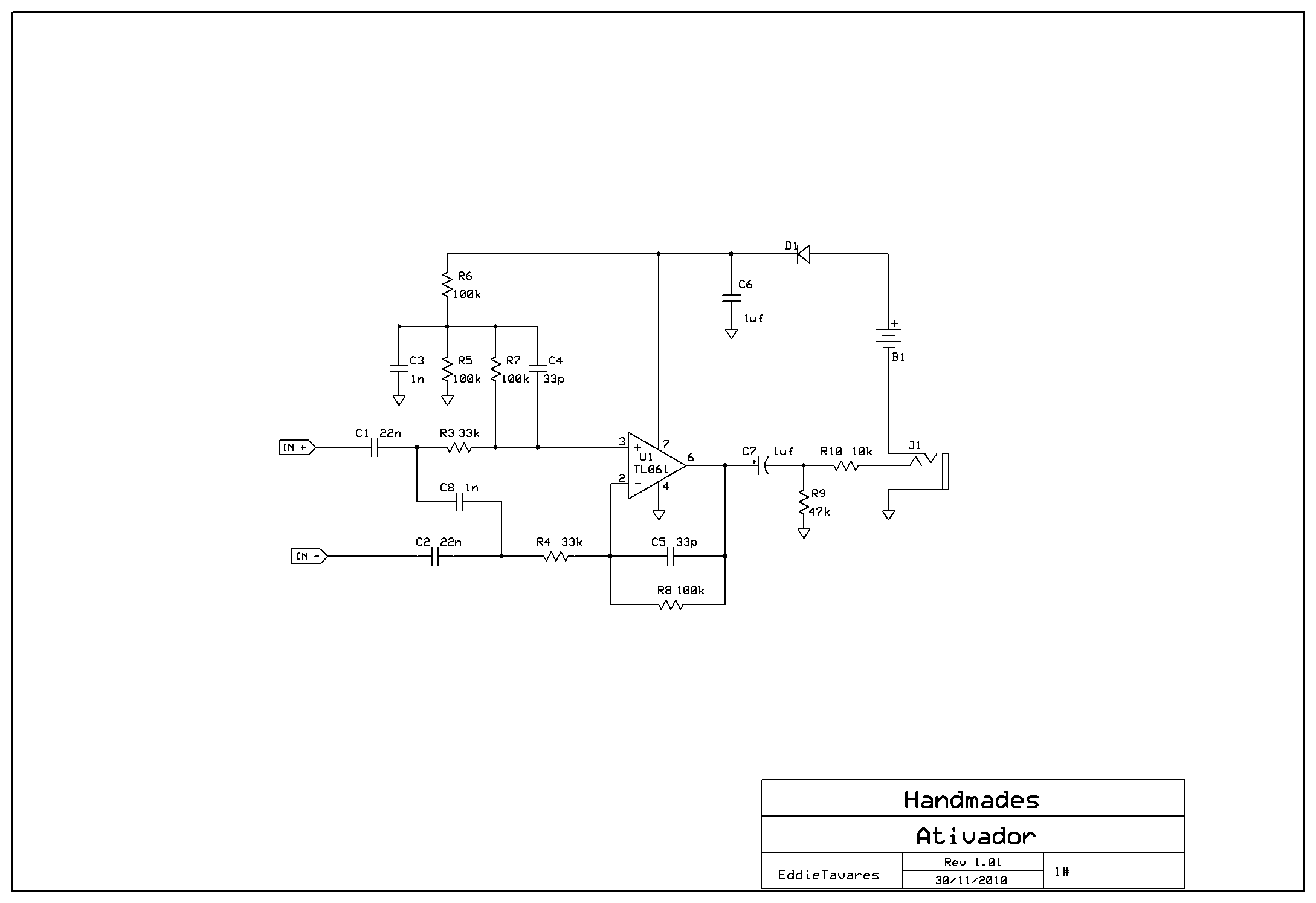
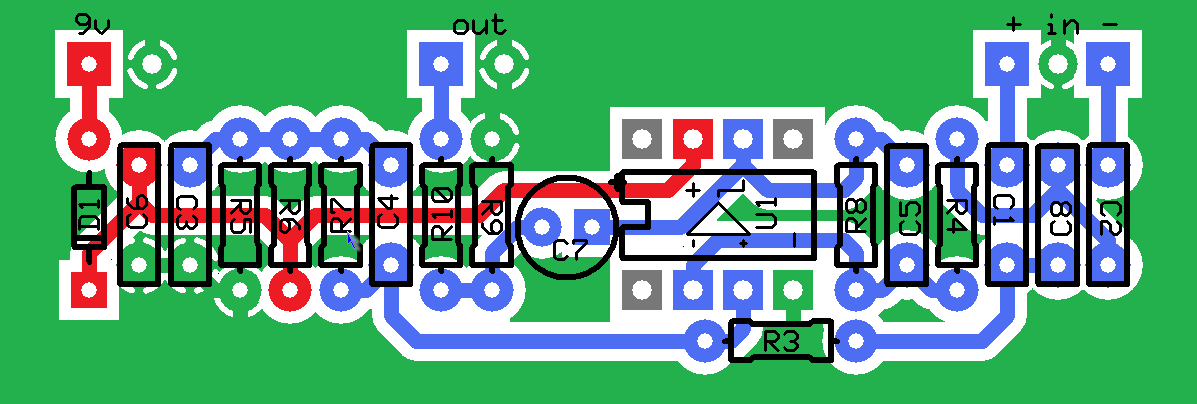
For those of you who can’t find the LM4250 here’s another active pickup circuit designed by Ed Tavares of Handmades from Brazil that uses the TL061;

Here’s the freestompboxes.org forum topic on the EMG 81 for reference; http://freestompboxes.org/viewtopic.php?f=3&t=880