 |
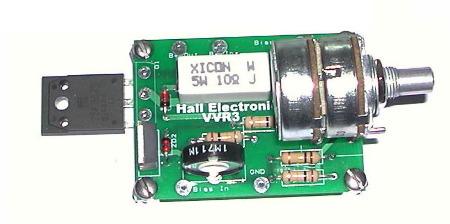
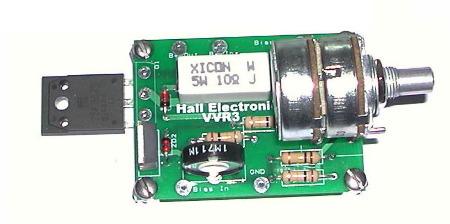
| Dana Hall’s VVR3 PCB kit. |
Power Scaling (a London Power trademark) and VVR, which stands for Variable Voltage Regulator, (Dana Hall of Hall Amplification’s version of Power Scaling) are currently two of the hottest topic’s in the Guitar Amp world. Both are methods which allow you to scale back the voltages within your amplifier to attenuate the overall volume without having to use a cumbersome purpose built attenuator between the amplifier’s output transformer and speaker or rely on a simple “Master Volume” control which dials out the all important power tube clipping.
Voltage scaling is said to allow you to maintain “that” tone you get from running a tube amp flat out with all the volume controls turned up to the max but also allow you to maintain your relationships with neighbours/children and/or spouses without having to resort to playing your guitar in an underground bunker.
Best of all this technology is compatible with 99% of amps below 50W!
Firstly; SAFETY! If you’re not confident working with the voltages associated with tube amplifiers don’t even bother with this, you WILL end up toast.
Secondly; what is “Power Scaling” e.t.c, why use it and how does it work? Well, take these explanations from the London Power website;
“[Power Scaling’s] goal is to achieve the same tone as our loud sound but at a much lower volume.”
And;
“Power Scaling, when implemented correctly, will reduce amplifier loudness by reducing the power generated. This has the added benefit of extending tube life while retaining “cranked” amp tone at any loudness level. Power Scaling can be applied to any tube amplifier, regardless of bias method or push-pull versus single-ended.”
You may just wonder why not use an attenuator? Well, London Power has this to say regarding attenuators (and remember there *may* be a slight bias in their explanations!);
“Not at all! “Speaker load boxes”, “speaker emulators,” and “speaker attenuators” are all forms of attenuation that are interposed between the output of a power amp and the speaker. They work for some people but are notorious for sounding “buzzy” at high attenuations.
A speaker attenuator forces your amp to be run flat out, producing its full power all the time. The power that is not needed is thrown away as heat, with the required power going to the speaker. It is quieter than full-tilt, but now the speaker is isolated from the amp and cannot interact with it, so some tone is lost.”
” If you only play clean or you only use preamp overdrive or distortion tones, then a ‘master volume’ will satisfy you.
“It makes the B+ on your amp variable like using an external variac only unlike the variac it doesn’t affect your heater voltage. As you turn down the voltage on your tubes you drop the power but keep a lot of the characteristic distortion and sustain only at a lower volume.
It reduces the output of the preamp IF you regulate the whole amp VS just the power tube(S). Since the power tubes are also operating at reduced voltage, they are actually easier to saturate. If you regulate just the power section and keep the voltages normal on your preamp tubes then you will need a MV to keep the preamp from over driving your power tubes. If you regulate the whole amp the preamps voltage is also reduced and the gain structure between the preamp and power amp is maintained.”
Now, for a huge amount of information regarding VVR check out this pdf document written by Dana Hall. It includes *almost* everything you would need to know about voltage scaling amplifiers including how you select the right VVR circuit for your amp (be it cathode or fixed biased), what parts of your amp you should scale (preamp, phase inverter, power amp) and how to install VVR in your amp;
Now here’s what a Valve Junior circuit looks like with a VVR circuit installed to regulate the whole amp;
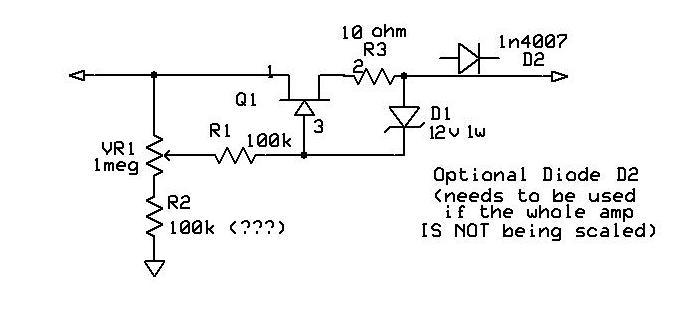
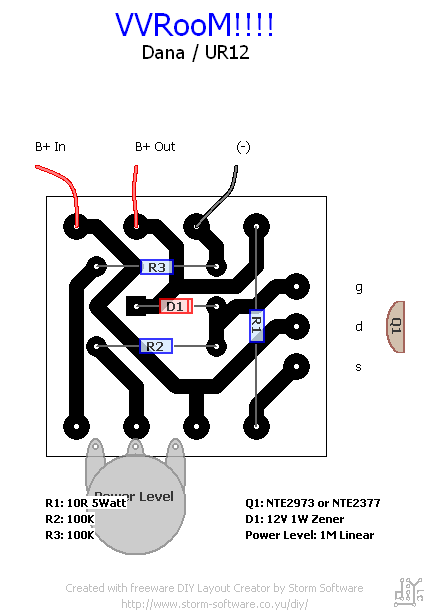
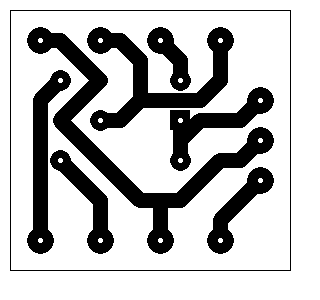
Here’s a schematic of the VVR schematic and PCB layout for cathode biased amps (for more info on amp bias types check out the VVR pdf above);