The Mod
Parts:
- Joyo Ultimate Overdrive
- 500K Log Potentiometer (link has a drop in replacement for the board mounted one)
- 1K5 Resistor
- 470K Resistor
- 100nF Capacitor
Schematic
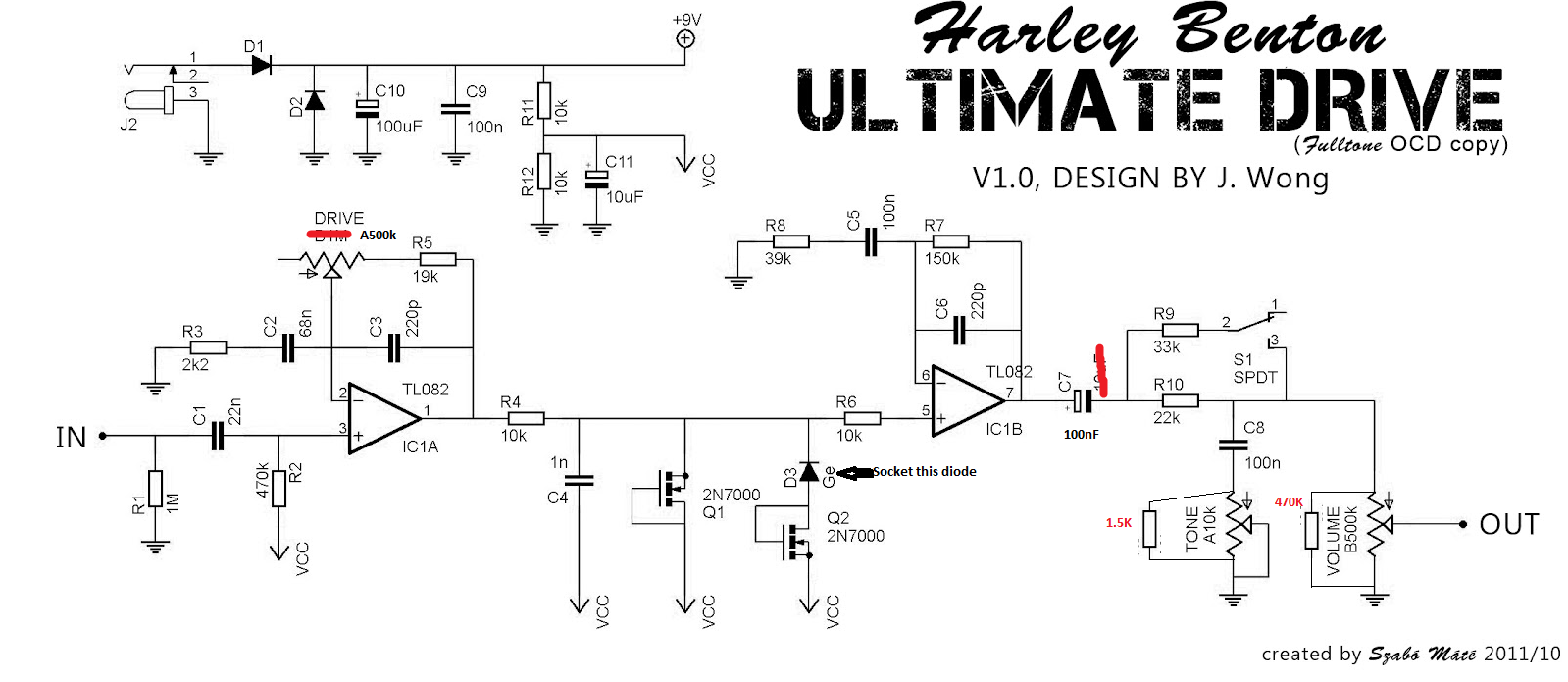
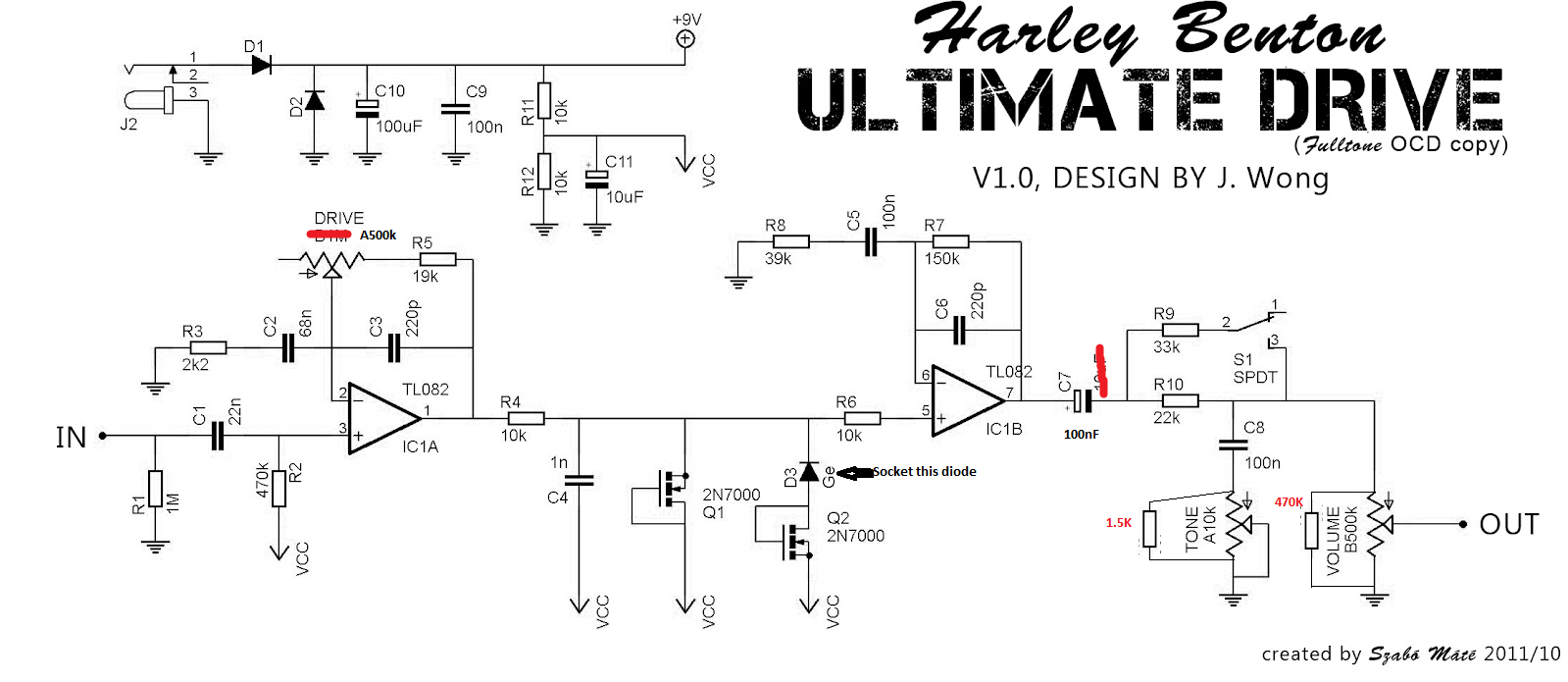
Here is a schematic of the changes we’ll be making. We’ll then go step by step through how to perform the mod.
Steps
When desoldering, it will probably be easiest to do it from the underside of the board. I recommend marking which components to remove on the underside. Then you can put the board back into the enclosure and use the enclosure to stabilize the board while you desolder.
- Desolder the drive pot and replace it with the 500K Log pot. This will give you a smoother transition through the gain range of the pedal. Alternatively, you can solder a 330K resistor across the outside lugs of the gain pot per the original mod.
- Solder the 1K5 resistor to the outside lugs of the Tone pot. (You may find it easier to do this on the under side of the board)
- Solder the 470K resistor to the outside lugs of the Volume pot. (See note in step 2)
- Remove C9, a 1uF capacitor, and replace it with the 100nF capacitor.
Note: If you have a board version prior to “2010.11.24” then you’ll need to replace C7, which is a 10uF, instead. - If you’re board has a version date of “2010.11.24” (which all the recent ones do) then you’ll need to remove the germanium diode and turn it around. The silkscreening is wrong and means that only one half of your signal will be clipped if you don’t change this. I put sockets on the underside so I can easily swap out different diodes to taste.
- Optional: The wires from the footswitch to the main board are cheap and prone to breaking. I recommend replacing all of them with some good wire so it doesn’t die on you when you’re playing live.
What it does
The mod is fairly simple as far as theory goes. The original mod by Freekish Blues uses 3 resistors in parallel with the pots to lower their values and thus limit their range. By using a 330K resistor, the gain pot goes from 1M down to 250K. I prefer to just swap it for a 500K Log pot since this is the preferred value on the OCD. Also, the log taper makes it a smoother transition across the gain range so it doesn’t need to be limited to just 250K. The volume pot gets reduced in the same way from 500K to 250K.
The tone pot is a bit more interesting. It forms a simple low pass filter with the 100nF capacitor. With the pot turned all the way up the cutoff frequency is originally about 16k. By reducing the value of the pot with the parallel resistor, we get a different cutoff frequency. The 1K5 resistor takes our tone control down to a value of 1.3K which is pretty cool since we can’t just go buy a potentiometer of this value. By doing this the cutoff frequency becomes roughly 122K. Now, to be fair, you can’t hear about 80% of those frequencies…but it is brighter. Also, since the tone pot is a log taper, you’re going to have a really wide range of usable settings across the whole knob.
Lastly, the capacitor change just limits how much bass is allowed to pass through the circuit before hitting the tone control.
I hope you found this a helpful bit of info. If you did then leave a comment telling me what you found most useful so I can focus on those things in later posts. Also feel free to leave a link to any pics of your mods.