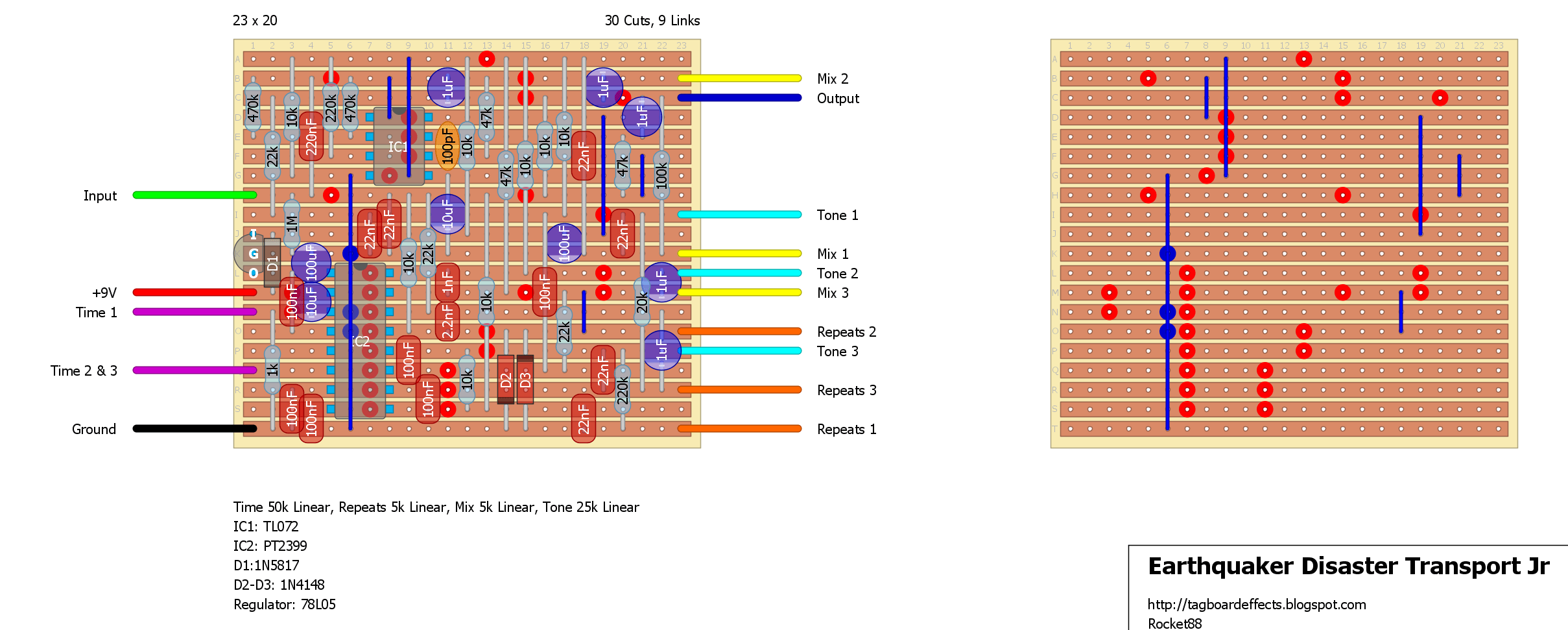
Had a sleepless night, so I decided to knockout some new layouts before the end of the new year. This one kicked my ass a bit, but I got it as small as I could. a nice sounding delay, that’s similar in architecture to the Deep Blue Delay. It’s a nice sounding warm, natural delay.
From the source:
The Disaster Transport JR is an analog voiced digital delay with 625ms
delay time with an all analog dry signal path and true bypass switching.
It was designed as an anti-modern delay for those who appreciate a nice
vintage tape echo with all it’s peculiarities. Its unique tone control
doubles as a noise filter on longer delay settings and really helps the
delay shine with a dirty signal. The mix control allows you to boost the
effected signal to nearly 4x the original signal level and the repeats
control goes from one signal repeat to near infinite repeats all the way
through to self oscillation.
Controls
Mix: Sets the
output level of the effected signal. This should be treated as a gain
control/master volume for the delay line. Unity is around noon and
everything above noon will boost the delayed signal louder than the
original. This is a gain control so, like any pedal with a lot of gain, a
hint of noise and distortion at max setting is completely normal.
Tone:
Most delay pedals are heavily filtered at the output to remove the
clock noise and other unwanted hash that is common from extending the
range of the delay time beyond the limit of the circuitry. This usually
leaves the delay sounding dark, muddy and disappear when hitting it with
dirt. The Disaster Transport has done away with a lot of the heavy
filtering and replaced it with a tone control which allows the user to
choose their desired sound and results in more natural tape-like
repeats. The tone control is at it’s darkest fully counter clockwise and
brightens as you turn it clockwise. A good rule of thumb is to leave
the tone control between off (fully counter clockwise) and noon at
longer delay times. This will remove all the common noise from
hyper-extending the circuit.
Time: From about 30ms fully counter clockwise to about 625ms fully clockwise.
Repeats:
Sets the regeneration of the delay line. From one single repeat fully
counter clockwise, subtle repeats around 9 O’clock, strong naturally
decaying repeats at noon, near infinite repeats around 2 O’clock and
full on self oscillation fully clock- wise.
Original:
switch wiring, you’re going to use a DPDT switch with the input and output wires going
directly to the sockets. With tails the stomp here will cut new signal going into
the PT2399 and so when bypassed the output of the PT2399 will continue repeating with the last input it received and the repeats continue, and IC1 will then act as a buffered
bypass. You may want to to swap the 47K resistor at pin 7 of IC1
for a 50K trimmer so you can adjust the buffered bypass level so you can have to
perfect unity with your bypassed signal. Another alternative is that you
can add a second stomp to true bypass the whole thing which will give you the option to mechanically bypass the effect as usual, or simply bypass with tails when you want.