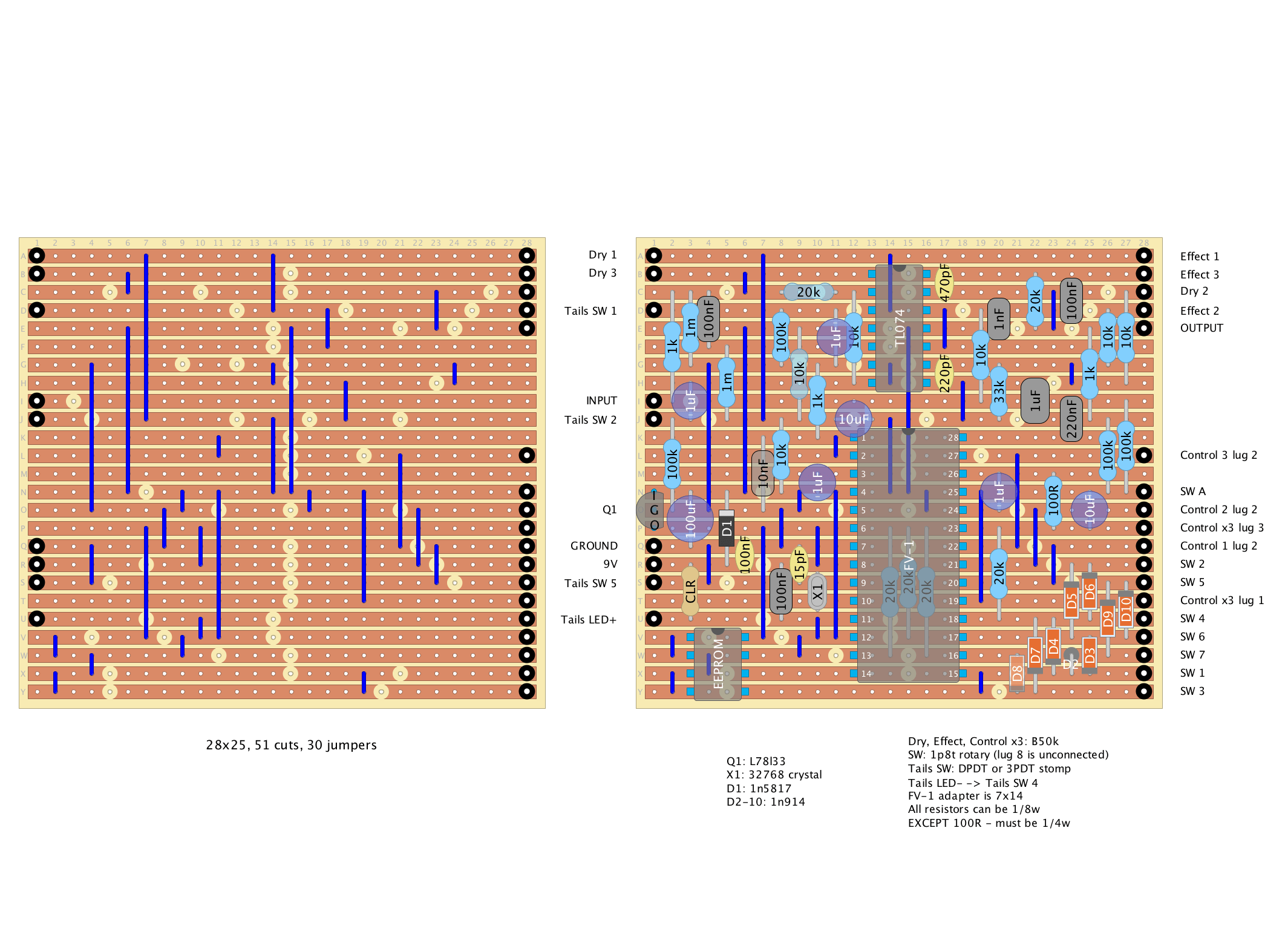
Once again, a guest appearance. Chris at CDC was brave enough to dabbling with some Spin FV-1 processors. Yes, these are SMD parts there is several vendors online that sell adapter boards.
This one is VERIFIED.
Since I started building
effects in 2020, there has been a “level up” step I’ve been avoiding. As
the level digital signal processing that is available through industry
standard effect makers like TC Electronic, Boss, Line 6 and Strymon
filters down to the DIY/hobbyist level – there really is no excuse for
not at least TRYING digital signal processing.
The most
commonly available engine of these DSP effects is the Spin FV-1 reverb
processor. They are about $10-$15 each and have 28 tiny little surface
mount legs that need to be soldered to tiny little pads on the circuit
board without any bridging. So I’ve been squeamish and avoided them.
Until now (dun dun).
After about 3 years of doing this I
felt like my dexterity and soldering iron proficiency had progressed to
the point where I shouldn’t put this off any longer. I also MUST thank
DK pedals for their tutorial that was a serious confidence builder.
This
effect contains that chip – soldered to an adapter board designed by
MAS Effects, which is attached to my stripboard layout of the Madbean
Headtrip 2 FV-1 project. It also contains the algorithm chip from that
project featuring the presets designed by Brian of Madbean..
The
5 knobs are for dry and effect level, as well as three parameters that
change with each effect preset. There’s a lot to cover with this pedal,
which is why my video is about 5 times longer than anything I’ve posted
so far… if you make it through all 8 clips, I salute you!!!
Mode
1: Choir – similar to the EQD organizer, with the controls condensed to
three knobs: octave down, octave up, and choir (which has a slight
delay on the signal)
Mode 2: Filter+Octave – an
envelope follower that is controlled by knobs 1&2, with an octave up
and down dialed in by knob 3.
Mode 3: Detune+Tremolo –
this is similar to the “detune” mode on the Whammy pedal. Its’s a faux
chorus of sorts. Knobs 2&3 control the speed and depth of the
tremolo
Mode 4: Flangecho – an 850ms delay. Length and repeats are knobs 1&2, flanging level in the repeats is knob 3.
Mode
5: Echo+??? – a 975ms delay. Knobs 1&2 are the same as mode 4. Knob
3 controls a multi effect that goes from modulation to buzzy ring
modulation to tremolo in the repeats.
Mode 6:
Flangeverb – knob 1 is the reverb level, knob 2 is the low cut, knob
three blends in a similar flange modulation as on mode 4.
Mode 7: Choirverb – a “shimmer” reverb with verb level on 1, low cut on 2, and octave up & down on knob 3.
Mode
8: 4th/5thverb – reverb level on knob 1, 4th down on knob 2, 5th up on
knob 3. This doesn’t show quite as much on the video but this is
definitely the most organic/analog synth-sounding patch of these 8 (in
my opinion)
Now the footswitches: the left switch is a “master on/off” that bypasses the entire circuit.
The
right switch kills the input to the effect chip and allows the
reverb/delay/choir to trail off naturally. HOWEVER – this will keep the
dry blend knob in play and depending on where you have it set, this knob
can boost the heck out of your signal. Which can be a good or bad
thing… up to you.
Are any of these sounds “usable”?
That’s a matter of taste, of course, but at the very least, NONE of them
are delicate. Thanks for reading this far…
-Chris, CDCE